
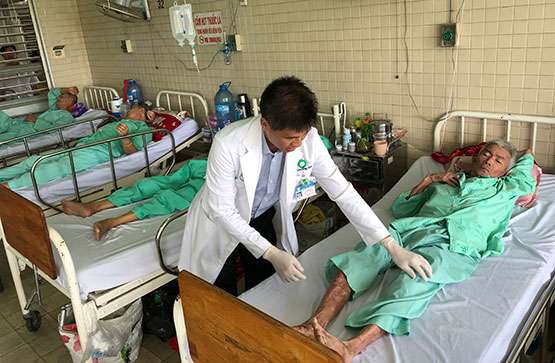
Currently every day at the Department of Vascular Surgery, Cho Ray Hospital receives 50-60 patients for examination and treatment; Among them, about 1/3 of patients have occlusive disease of the lower limb arteries. Most patients are hospitalized in severe condition - ulcers, necrosis of toes and feet. As a result, many cases require leg amputation.
If I can’t walk, I’ll be hospitalized
Recently, patient Dao Van Quan (born 1959, from Ben Tre) was brought to the local hospital by his relatives with pain in his legs and was unable to walk. Immediately after that he was transferred to Cho Ray Hospital. Here, the patient was diagnosed with clogged arteries in the lower limbs, many ulcers appeared on the soles of the feet, leg muscle atrophy, and poor blood flow to the lower limbs.
 Dr. Lam Van Button is examining a patient
Mr. Quan said that for many years he has often suffered from numbness and pain in his feet and legs. I thought my joints were due to old age so I didn’t go see a doctor. Recently, the pain was so severe that he could not walk, so he asked his children to take him to the hospital.
Another case is patient Tran Van Hau (born 1943, hometown of Tien Giang).
Dr. Lam Van Button - Head of the Department of Vascular Surgery, Cho Ray Hospital - said that patient Hau had blockages in the femoral artery and the artery below the knee on both sides. In addition, patients also suffer from diabetes, blood pressure, and blood lipid disorders. This is the reason why the condition becomes more severe and complicated. The patient had ulcers and necrosis of the 2nd, 3rd, 4th toes and big toes of both feet; Ulcers under the soles of both feet, infection. Therefore, patients need treatment for many years. After the doctor’s intervention, the patient must comply with wound care treatment on both feet, take medication as prescribed, and have regular check-ups to hopefully save both feet…
Patient Bui Kim Tuoi (74 years old, from Dong Thap) is not as lucky as the two patients above. Relatives of Ms. Tuoi said that more than a week ago she was taken to Sa Dec Hospital (Dong Thap) due to pain in her legs and could not walk, then was transferred to Cho Ray Hospital. At Cho Ray Hospital, the doctors said her condition was too severe, forcing her right limb above the knee to be amputated.
Need to check blood vessel status
According to Dr. Node, lower limb artery occlusion is a disease of lack of blood supply to the lower limbs; Typical signs are numbness, fatigue, and pain in the legs. In the mild stage, even though there is pain, the patient can still walk a few hundred meters, and must rest before being able to continue walking. In the severe stage, even when lying down, the patient still has pain. In more serious cases, the toes can become necrotic, even the entire foot or leg is necrotic… The cause of up to 85-90% of patients is atherosclerosis. With age, older patients have increasingly atherosclerosis, which leads to narrowing of the arteries, especially narrowing or occlusion of the arteries of the lower extremities. However, when there is pain, patients are often subjective, try to endure it and go to a hospital with a specialist for examination late…
Dr. Button recommends: “When elderly patients have symptoms of numb legs and tired legs, they need to go to a hospital with a vascular specialist to check the blood vessels of the lower limbs, diagnose and treat them promptly. Besides, an effective prevention measure is that people should have annual health check-ups, especially people over 60 years old must have their blood vessel status checked.”